

Art, Graphics, Blue

Chief Information and Digital Officer

Nature, Outdoors, Sky, Azure Sky, Cloud, Architecture, Building, Office Building

Welcome to the University of the Sunshine Coast


As one of Australia's fastest growing universities, UniSC offers real opportunity for skilled and determined leaders who want to make an impact in higher education.

Founded in 1996, UniSC opened its first campus on the Sunshine Coast following a campaign from local residents who advocated for locally provided tertiary education. Since then we have expanded our footprint into other regional areas that previously lacked access to higher education and now have more than 20,000 students.

We work closely with local leaders, industry and non government partners to ensure programs, research and support services are aligned with each region's needs. The success of this model shows in our student numbers, with consistent enrolment growth every year we have operated. We expect this to continue as South East Queensland's population grows, especially on the Sunshine Coast and in the Moreton Bay region, where we are expanding our award winning campus and facilities.

As our size has grown, so too has our reputation. We are one of the most respected universities in Australia for teaching quality, recognised by our five star rating in the Good Universities Guide. On the world stage we are a recognised leader in sustainability, ranked seventh globally for Life on Land in the 2025 Times Higher Education Impact Rankings and in the world's top 25 for four further United Nations Sustainable Development Goals.

We are young, agile and determined to become Australia's premier regional university. We warmly encourage you to join us on this journey.

Professor Helen Bartlett
Vice-Chancellor and President


IT and Digital Services


IT and Digital Services provides the technology resources that support the University's academic programs, research, community engagement and administrative services across multiple campuses.

The function develops, delivers and supports the University's core technology environment. Its remit covers enterprise services, client services, innovation and project delivery, and operational governance. This includes business application services, data integration and digital platforms, cyber operations, workplace technologies, and innovation services.

The function delivers projects under the governance, assurance and gating framework of the Enterprise Portfolio Management Office, which leads enterprise architecture and change management for the University. Data governance and analytics are led by the Insights and Analytics function. The Director works closely with both.

Operating context

  • Operating budget of approximately $23 million
  • Headcount of 80 or more

Structure

The Chief Information and Digital Officer reports to the Chief Operating Officer.

The function is organised around its core service groups, shown below at a high level.
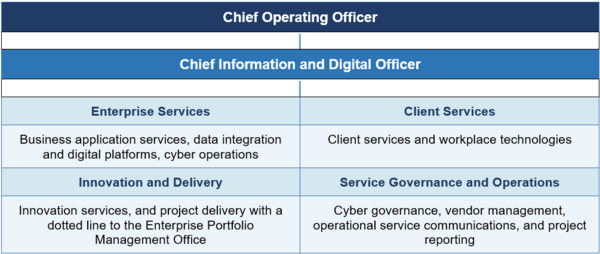
CIDO.png

About

Primary objectives

  1. TBC
  2. TBC
  3. TBC

Duties

Specific accountabilities for this role include:

  1. Lead, develop and unite the IT and Digital Services team, building a single high performing team with a shared sense of purpose, and lifting culture and engagement through change.
  2. Lead the development and delivery of the IT and digital services plan and roadmap, integrated with the University's Strategic Plan and Strategic Investment Plan.
  3. Provide strategic direction and oversight for the design, operation and support of the University's core technology services, infrastructure and enterprise applications, so that they are reliable, secure and fit for purpose.
  4. Deliver efficient and effective infrastructure, enterprise applications and digital services through cloud based and contemporary ways of working.
  5. Lead cyber operations, ensuring appropriate security systems, monitoring and response are in place to protect the privacy and integrity of the University's information.
  6. Maintain currency on emerging technologies and advise on those that should be adopted to keep the University's technology services responsive to its needs.
  7. Provide digital enablement that improves the experience of students, staff and researchers.
  8. Lead project delivery within the function, with a dotted line to the Enterprise Portfolio Management Office, ensuring delivery follows the EPMO governance, assurance and gating framework.
  9. Partner with the Insights and Analytics function on data management and analytics, ensuring technology services support sound data practice.
  10. Partner with the Campus Development and Services function on capital works projects, including campus expansion projects.
  11. Build strong relationships across the University with executives, business partners and stakeholders, supporting collaboration, innovation and continual improvement.
  12. Provide high quality reporting to the Chief Operating Officer and relevant University committees.
  13. Develop technology standards, governance processes and performance metrics to ensure IT and Digital Services delivers value.
  14. Develop and control the annual operating and capital budget for IT and Digital Services, ensuring investment is consistent with the University's strategic objectives.
  15. Oversee and advise on the procurement of technology resources, equipment and services, managing budgets transparently with vendors and partners.
  16. Develop IT policies, procedures and governance to support the legal obligations, security arrangements and strategic direction of the University.
  17. Comply with all University policies and procedures, in particular those relating to work health and safety and equal opportunity.
  18. Provide high level advice to the Chief Operating Officer so that services, plans, policies, processes and systems are aligned to University objectives.
  19. Undertake other duties as determined by the Chief Operating Officer.

Selection Criteria

Applicants need to demonstrate they meet the following knowledge, skills and experience:

  1. Outstanding people leadership, with a proven record of building and uniting teams, lifting engagement and culture, and giving a team a shared sense of purpose and direction.
  2. Demonstrated success leading cultural and organisational change and transformation, bringing people with you to establish a high trust, high performing and service oriented team.
  3. Demonstrated leadership and people management across multidisciplinary teams in a technology enabled environment.
  4. Demonstrated success in managing technology infrastructure and services for a large, complex organisation with a wide variety of stakeholders.
  5. A sound understanding of current and emerging technologies and how they can be applied to improve services, including through periods of change and financial constraint.
  6. Strong analytical and planning skills and the ability to demonstrate the value of technology services to the organisation.
  7. Extensive experience in financial management, including budgeting, planning and the financial assessment of service or technology changes.
  8. Experience operating within project and portfolio governance frameworks led by a separate delivery office, ensuring technology resources support delivery on scope, time and budget.
  9. High level written and oral communication skills, including the ability to prepare documentation for internal, external and executive audiences.
  10. A sound knowledge of and commitment to work health and safety principles and the ability to implement these at a service level.
  11. A commitment to enhancing the student and staff experience through technology.
  12. A relevant degree and extensive related experience.
    Desirable
  13. Knowledge of or experience within a university environment and an understanding of the challenges facing Australian universities.

Recruitment process

How to apply

[TO CONFIRM] Insert closing date once confirmed.

[TO CONFIRM]  Your completed application must include a resume, cover letter, and a response to selection criteria as defined within the position description.

Contact 

Have questions or want to know more? For a confidential discussion, please contact:

[TO CONFIRM] Insert recruiter name and contact once confirmed.

Candidates may be requested to undergo psychometric testing and give permission for verification of their identification and tertiary qualifications, in addition to an Australian Federal Police check.

Further information

UniSC's campuses span from Moreton Bay to the Fraser Coast.

Our strategic expansion of campuses and specialist facilities has brought more higher education opportunities into regional communities from Moreton Bay to the Fraser Coast.

Our campuses feature simulation labs, visualisation studios, nationally accredited sporting facilities, collaborative workspaces and open areas for social activity. We hold strategic partnerships with industry leaders and service providers in shared facilities, where we collaborate on teaching, learning and research.

Our impact on economic, social, cultural and environmental development is clear, with more than 20,000 students, a diverse offering of in demand programs, significant investment in infrastructure and billions flowing into the local economy, including through the contributions of our graduates.

Campuses and locations

  • UniSC Sunshine Coast, including Sunshine Coast Health Institute, Thompson Institute, Innovation Centre and UniSC Clinical Trials Sippy Downs
  • UniSC Moreton Bay
  • UniSC Caboolture and UniSC Clinical Trials Morayfield
  • UniSC SouthBank and UniSC Clinical Trials SouthBank
  • UniSC Gympie
  • UniSC Fraser Coast and the K'gari Research and Learning Centre

UniSC's organisational structure supports its ambitious agenda. Strong portfolios and flat, clear reporting lines support accountability, flexibility and responsiveness.

The University is governed by an 18-member Council, led by the Chancellor.

The Vice-Chancellor and President is responsible to University Council for strategic development, organisational leadership and day to day operations, including governance and risk management. People and Culture reports to the Vice-Chancellor and President.

The Deputy Vice-Chancellor Academic oversees the academic functions of UniSC and related support areas including Schools, the Academic Support Unit and the Library.

The Deputy Vice-Chancellor Research and Innovation leads research, innovation and commercialisation, overseeing all Research Centres and Institutes, including the Clinical Trials Centre and the Graduate Research School.

The Chief Operating Officer advises on and oversees business functions to ensure the University's ongoing viability. The COO portfolio includes Campus Development and Services which includes Facilities Management and UniSC Sport, Marketing and Communications, Insights and Analytics, IT and Digital Services, the Enterprise Portfolio Management Office, and Major Projects.

The Pro Vice-Chancellor Global and Engagement is responsible for the Advancement Office, the Art Gallery, the International Office, Community Engagement, and a number of campuses.

Our purpose is to transform lives through learning and knowledge in every place we operate and with every community we serve.

Our values

  • Integrity. We uphold our commitments, lead by example, take responsibility, and make decisions transparently.
  • Community. We make a positive difference by working collaboratively, building partnerships, and fostering an inclusive and equitable environment.
  • Sustainability. We foster the wellbeing of communities and our environment for current and future generations, working toward net zero by 2050.

Our 2035 aspiration

Over the next ten years UniSC will adopt a challenger mindset and aims to be a national leader in personalised learning and support, a global leader in applied research for healthy people and a healthy planet, and a globally engaged university serving more than 30,000 students through onshore, online and transnational education.

Pillars

  • Students at the heart, securing the future of educational service delivery through growth, diversification, equity and innovation in learning and teaching.
  • A people first workplace that cares for the health, safety and wellbeing of students and staff.
  • Research and partner engagement focused on sustainability, global challenges and connections in the Asia Pacific.
  • Vibrant and optimised physical, digital and campus operations across our domestic and global footprint, including transformation of digital, data and enabling services through a ten-year Strategic Investment Plan.

UniSC recognises and embraces diversity among our staff, students and community partnerships. We are committed to an inclusive environment where each person feels they belong and are respected, connected and empowered.

Our focus areas

  • Learning and working at all life stages
  • Aboriginal and Torres Strait Islander education
  • Cultural and linguistic diversity
  • Disability and inclusion
  • LGBTIQ+ and community
  • Gender equity

Women in leadership

UniSC is a recipient of the Athena SWAN Bronze Award through the Science in Australia Gender Equity initiative, recognising our commitment to improving gender equity and ensuring women from diverse backgrounds and underrepresented groups are positioned to reach their full potential.

Work life integration

UniSC is committed to a supportive working environment, with guidelines, policies and procedures to help all staff maintain a healthy balance. Arrangements include flexible hours, purchased leave, working from home and a range of leave options including parental and carer's leave.

The Chief Operating Office at UniSC is responsible for the strategic management of the corporate functions of the University and related support areas to ensure ongoing viability.

The COO portfolio includes Campus Development and Services which includes Facilities Management and UniSC Sport, Marketing and Communications, the Information and Analytics Unit, IT and Digital Services, the Enterprise Portfolio Management Office, and Major Projects.

The COO is Kylie Colvin.

Kylie is an executive leader with a record of delivering large scale transformation across complex, multi campus universities. Her work spans strategic planning, financial sustainability, capital and digital infrastructure delivery, and enterprise-wide governance. She holds a Master of Business Analytics from Deakin University and a Bachelor of Arts in Economics and Mathematics from the University of Sydney.

Kylie joined UniSC from the University of Nottingham, where she was Chief Strategy Officer leading an institution wide transformation program focused on long term growth and financial resilience. Before that, as Chief Strategy and Operations Officer at the University of Nottingham Malaysia, she led the development and delivery of the University's strategic plans, major campus infrastructure projects, and enterprise-wide digital modernisation. During that time the institution exceeded enrolment targets, strengthened governance and risk frameworks, and delivered significant capital and systems programs.

Earlier in her career Kylie held senior leadership roles at the University of Sydney and Macquarie University and co-founded a higher education consulting firm advising universities internationally on strategy, growth and operating model design.

As a member of the University Executive, Kylie leads the Chief Operating Office portfolio.

Why join UniSC


We’re all about doing work that matters, connecting with great people, and being part of an incredible journey. While we’re not the largest university, we are one of the fastest growing in Australia, now with over 2,000 staff across five campuses in South East Queensland and an expanding presence in major capital cities, and we’re making a big impact every day through ground-breaking research, a strong commitment to sustainability, high-performance sport, and award-winning alumni.

We are committed to delivering high-quality research and teaching that address major global and regional challenges, with established and emerging strengths in sustainability, environmental systems, biodiversity, aquaculture, preventative health and regional resilience. Our research excellence is internationally recognised through strong performance in global benchmarking, including leading rankings in the 2025 Times Higher Education (THE) Impact Rankings for “Zero Hunger,” “Climate Action” and “Life on Land.” UniSC is also recognised for its teaching excellence, with a strong emphasis on student success, innovative and engaging learning experiences, and strong graduate outcomes that equip learners to make meaningful contributions in their chosen fields. As the only university operating within three UNESCO Biosphere Reserves and a UNESCO World Heritage Site, UniSC is uniquely positioned to leverage its natural environment to advance impactful research, teaching and partnerships that support sustainable futures, with sustainability embedded across all aspects of our teaching, research and operations.

We foster a collaborative and supportive environment that encourages continuous professional development and provides the tools and resources to grow your career. We value the contributions of every team member and the role they play in our culture and success. We’re not afraid to do things differently, and we’re looking for people who share our values and want to be part of a team working together to make a meaningful difference to local and global challenges.


The Organisation

UniSC’s organisational structure supports its ambitious agenda. Strong portfolios and flat, clear reporting lines facilitate accountability, flexibility and responsiveness.

Key statistics

A young university at the epicentre of progress. We’re a growing, comprehensive university focused on excellent teaching, ground-breaking research, championing sustainability, and producing award-winning alumni.

Our rankings

We’re a growing, comprehensive university focused on excellent teaching, ground-breaking research, championing sustainability, and producing award-winning alumni. 

Annual Report

View our achievements, challenges and performance against key indicators in our Annual Report.

Strategic Plan 

Our aspiration over the next ten years is to adopt a challenger mindset and be globally recognised in the following domains: Student success by design; World-class research at scale; Sustainability leadership; and Expanding global footprint.

Locations

UniSC stands as the world's sole university with campuses situated within three interconnected UNESCO biosphere reserves and the UNESCO World Heritage Listed K’gari.

Aboriginal and Torres Strait Islander Visual Identity

Comprised of the Knowledge is Sacred patterns and animal motifs, the UniSC Indigenous Visual Identity designs come from the original Bidjali painting created by esteemed Kabi Kabi artist Lyndon Davis which honours the cultures, histories, and knowledge of Aboriginal and Torres Strait Islander peoples and their connection to the UniSC community.

Art, Graphics, Blue